July 2, 2026
CoQun: Turning Science Into a Story Doctors Remembered
Most pharmaceutical launches depend on one of two advantages: a growing market or an early start. CoQun had neither.
Scroll down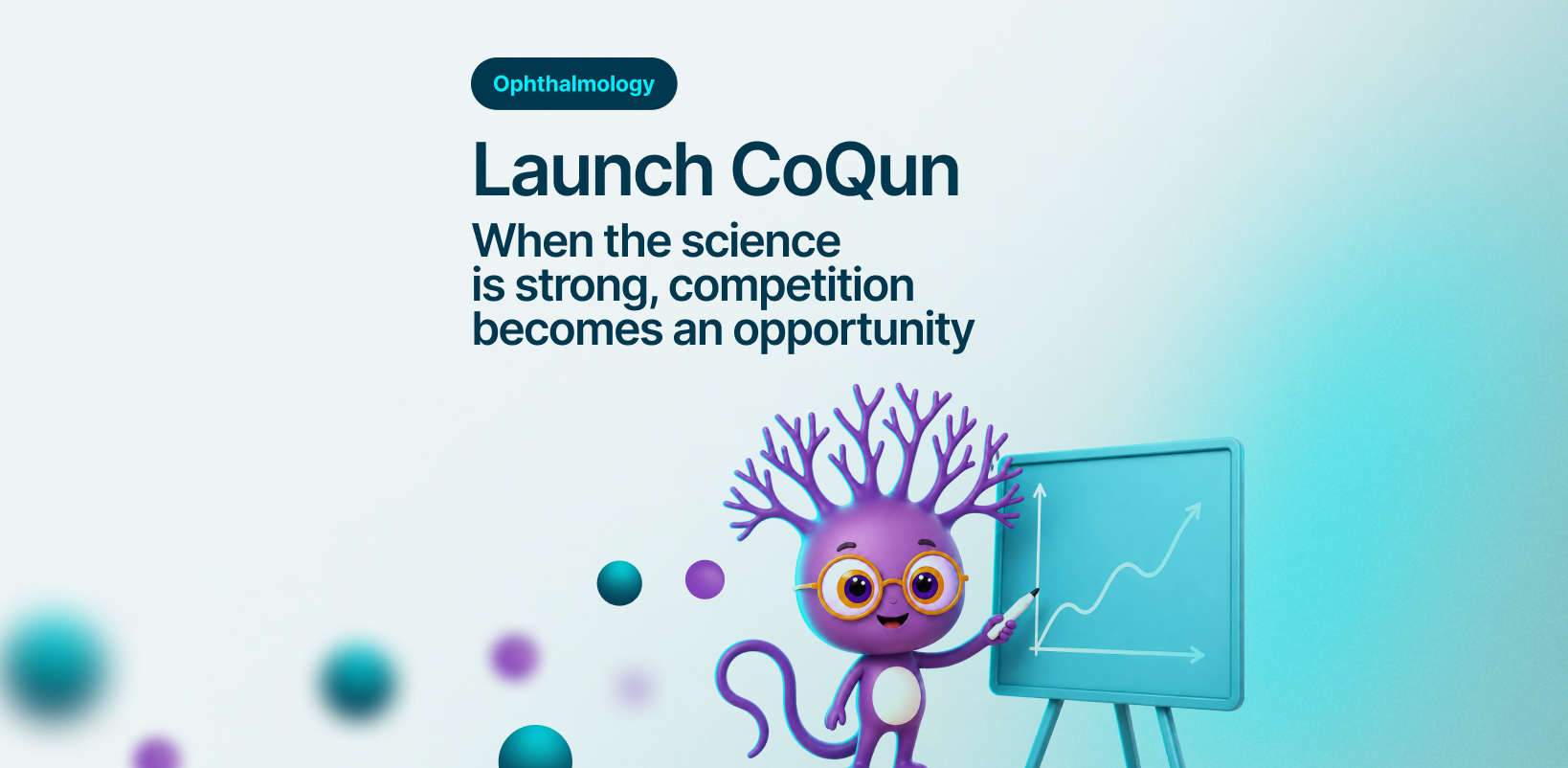
When the brand entered the Ukrainian glaucoma neuroprotection segment at the end of 2025, the category was already established. Competitors had spent years building their positions. CoQun was effectively the last major entrant into a space that was neither empty nor expanding fast enough to make room for another player. In 2026, the category was not showing active growth in either packs or value. That changed the entire launch logic from day one. This was never going to be a launch that won through timing alone.
The barrier to entry was high for another reason as well. Glaucoma remains one of the leading causes of irreversible blindness worldwide. It progresses silently, often without symptoms until vision loss is already permanent. The core patient group is older and already carries a significant financial burden from continuous treatment. Neuroprotection is not part of first-line glaucoma therapy, but it is increasingly seen as an important element of comprehensive patient management. For many patients, however, that also means additional cost. In practical terms, every new product in this segment enters not only a competitive space, but a cautious one.
That is why the team made a crucial decision early: the launch would begin before the product reached the market.
Before the first CoQun shipment arrived in Ukraine, the company had already started building a professional discussion around neuroprotection. Conferences, workshops, and expert meetings focused on ganglion cell preservation, mitochondrial dysfunction, and the importance of a broader approach to glaucoma patients. The goal was not to generate premature product attention. It was to prepare physicians to see the relevance of the topic itself. In other words, the team worked to build category understanding before asking the market to respond to a new brand.
That decision turned out to be central.
Too many launches begin with visibility. This one began with context.
The same principle shaped the company’s internal preparation. Medical representatives were trained not only on product characteristics, but on the concept of neuroprotection itself. They were expected to do more than present a product. They had to be able to hold a serious professional discussion with physicians. In a category like this, field communication is not just an execution channel. It is part of the strategic mechanism that determines whether a brand is perceived as credible or interchangeable.
But even that was not enough on its own.
The team understood that science, while essential, would not automatically make a complex topic memorable. Neuroprotection is clinically important, but not naturally easy to communicate. What the launch needed was an emotional code strong enough to make the idea recognizable without weakening its scientific seriousness.
That is how Ganglik was created.
Ganglik was built in the image of a retinal ganglion cell — the very cell whose survival neuroprotection seeks to support in glaucoma patients. The role of the character was precise: to make a difficult scientific topic more accessible, more human, and more memorable for physicians. At first, Ganglik appeared in educational materials, banners, presentations, messenger content, and sticker packs. Over time, the character moved beyond campaign design and became part of the daily language of the field team and physician communication. Later, a life-size Ganglik appeared at one of the largest ophthalmology conferences in Ukraine.
That was the turning point where the launch moved beyond communication and into culture.
Doctors began taking photos with Ganglik and sharing them on social media and in professional chats. What had started as a brand device became a recognizable symbol of neuroprotection within the ophthalmology community. At a certain stage, Ganglik stopped functioning as a marketing instrument and started functioning as a shared reference point inside the professional conversation.
The commercial result followed quickly. In the first four months after launch, CoQun reached a 15.4% market share and moved into third place in the category. It came close to a competitor that had already spent several years on the market, with less than one percentage point remaining to second place.
That result matters not only because of the number itself, but because of what it says about market behavior.
CoQun did not win by being first. It did not win by entering an easy category. And it did not win by relying on standard promotional mechanics. It won because the launch was built around a sharper sequence: prepare the market, deepen the expertise of the team, create a stronger professional conversation, and give the category a symbol people would actually remember.
There is a broader lesson here for pharmaceutical marketing. Physicians do not respond to noise. They respond to relevance, knowledge, and credibility. But credibility becomes stronger when a complex idea is not only scientifically sound, but also culturally memorable.
That is why the CoQun launch is more than a product story. It is a case study in how to build market entry when the market offers no natural opening. And it is a reminder that in pharma, the most effective launches are often the ones that do not begin with the product itself, but with the quality of the conversation built around it.
.png)